Few operas possess the enduring enchantment of Mozart’s “The Magic Flute,” a work that somehow balances fairy tale whimsy, Enlightenment philosophy, broad comedy, and spiritual allegory without collapsing under the weight of its contradictions. Premiering in 1791, mere months before Mozart’s death, the opera follows Prince Tamino’s quest to rescue Pamina, daughter of the fearsome Queen of the Night, only to discover that the world is far more morally ambiguous than it first appears. Villains become sympathetic, heroes uncertain, and the journey itself transforms into a search for wisdom, love, and inner illumination.
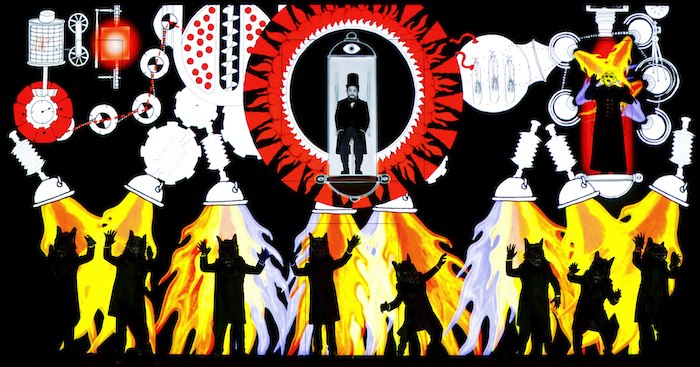
At LA Opera, the celebrated Komische Oper Berlin production arrives not merely as an opera, but as a dazzling act of cinematic imagination. Conceived by Suzanne Andrade with animation by Paul Barritt, the production reimagines Mozart’s singspiel through the language of silent film, replacing spoken dialogue with projected text cards and surrounding the performers with gorgeously surreal black-and-white animation. The result feels uncannily suited to Los Angeles, where early cinema still lingers like a collective dream in the city’s bloodstream. The visual invention is so relentless, so charmingly handcrafted, that one often feels suspended somewhere between opera house and vintage picture palace.
“Part silent film fantasy, part fairy tale, LA Opera’s The Magic Flute casts a spell that feels both nostalgic and utterly new.”
Against this endlessly inventive backdrop, the cast proves more than capable of grounding the spectacle emotionally. Soprano Sydney Mancasola brings warmth and lyrical radiance to Pamina, giving the character emotional gravity beneath the fantasy. As Tamino, tenor Miles Mykkanen offers a bright, earnest presence well matched to the prince’s idealism and spiritual awakening. But much of the evening’s comic vitality belongs to baritone Kyle Miller as Papageno, Mozart’s lovable bird catcher and eternal realist. Accompanied by an acrobatic black cat that repeatedly stole scenes and delighted the audience, Miller’s Papageno became the opera’s beating comic heart, his earthbound desires hilariously contrasting the lofty moral trials unfolding around him.
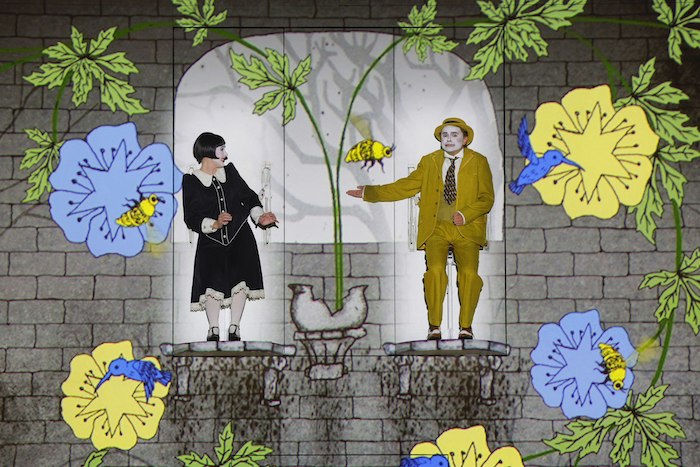
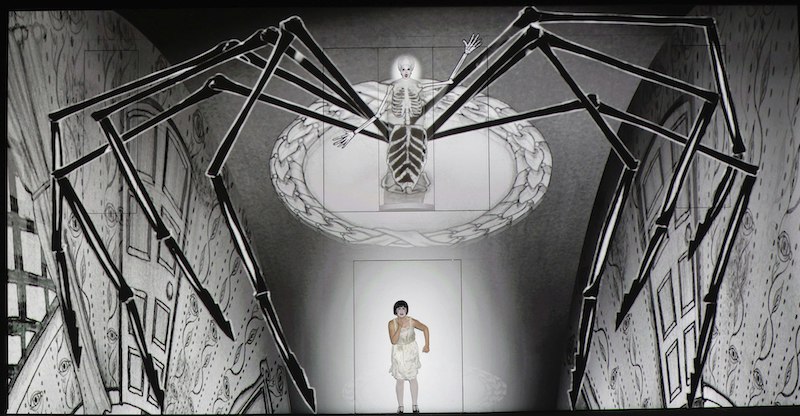
Emily Damasco’s Papagena, styled like a sultry Betty Boop apparition sprung from a 1930s cartoon, added yet another layer of visual wit to the evening’s silent-film aesthetic. Yet the night’s undeniable showstopper was soprano Aigul Khismatullina as the Queen of the Night. Appearing as a gigantic spider in one of the production’s most visually arresting images, she unleashed the famous “Der Hölle Rache kocht in meinem Herzen” with blistering precision and astonishing vocal firepower. The audience erupted into a standing ovation before the opera had even reached intermission, a rare and wholly deserved interruption to the performance.
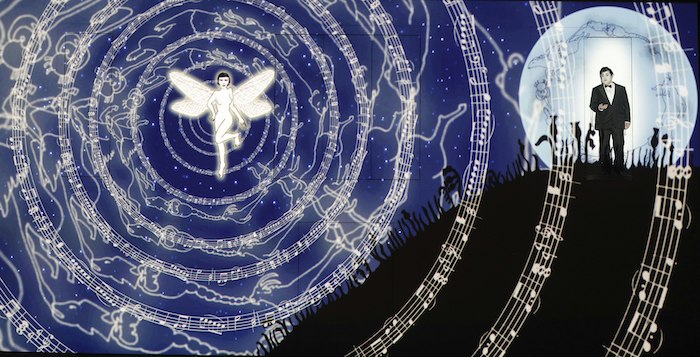
Musically, the evening carried additional emotional resonance as it marked the final performance of conductor James Conlon with LA Opera after a long and distinguished tenure. Conlon led the orchestra with elegance and buoyancy, allowing Mozart’s score to shimmer with both playfulness and emotional clarity. As the evening concluded, the audience witnessed a genuinely moving farewell: a magical shower of confetti descending from above, each glittering piece bearing Conlon’s name, transforming the curtain call into something almost mythic.
For all its visual ingenuity, what makes this “Magic Flute” so memorable is that it never loses sight of the opera’s deeper humanity. Beneath the fantasy, the talking animals, enchanted instruments, and comic interludes lies Mozart’s profound belief in enlightenment through compassion, wisdom, and love. This production understands that balance perfectly. It enchants the eye without neglecting the soul. In an era where many modern stagings strain desperately to reinvent the classics, this production accomplishes something rarer. It reminds us why the work became magical in the first place.
— Ghalib Dhalla
“The Magic Flute” plays at the LA Opera through June 21st. More information at https://www.laopera.org/
 indulge