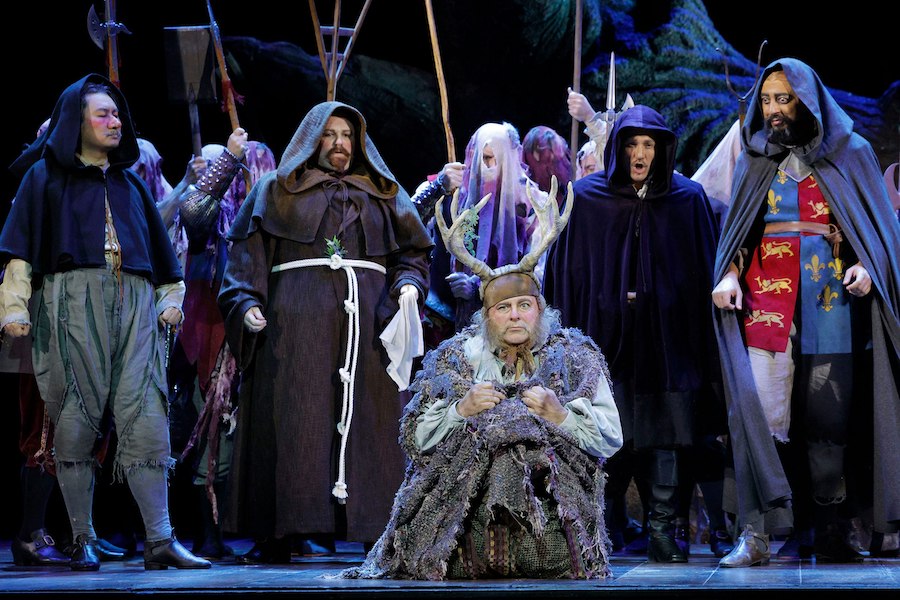
If Falstaff feels like a valediction, it is one delivered with a wink. Premiered in 1893, when Giuseppe Verdi was in his eighties, this late masterpiece turns from the tragic weight of Otello toward something fleet, conversational, and disarmingly humane. With a libretto by Arrigo Boito, distilled from The Merry Wives of Windsor and touches of Henry IV, Part 1, the opera charts the comic misadventures of Sir John Falstaff, an aging knight who, short on money and long on vanity, attempts to seduce two married women with identical letters and is repaid with a sequence of exquisitely plotted humiliations.
What distinguishes Falstaff, beyond its effervescence, is its form. There are no set piece arias to halt the action. Verdi writes in a continuous, quicksilver flow, closer to spoken drama than the stop and start architecture of his earlier works. The orchestra chatters, nudges, and laughs under the singers, turning dialogue into music without ever ossifying into display. The result is a score that feels alive in the moment, its wit inseparable from its motion.
“This is Falstaff as Verdi intended: nimble, irreverent, and gloriously alive in the hands of a finely tuned ensemble.”
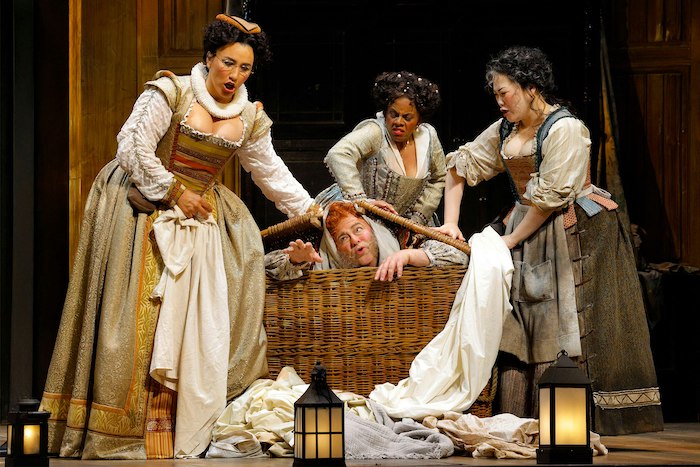
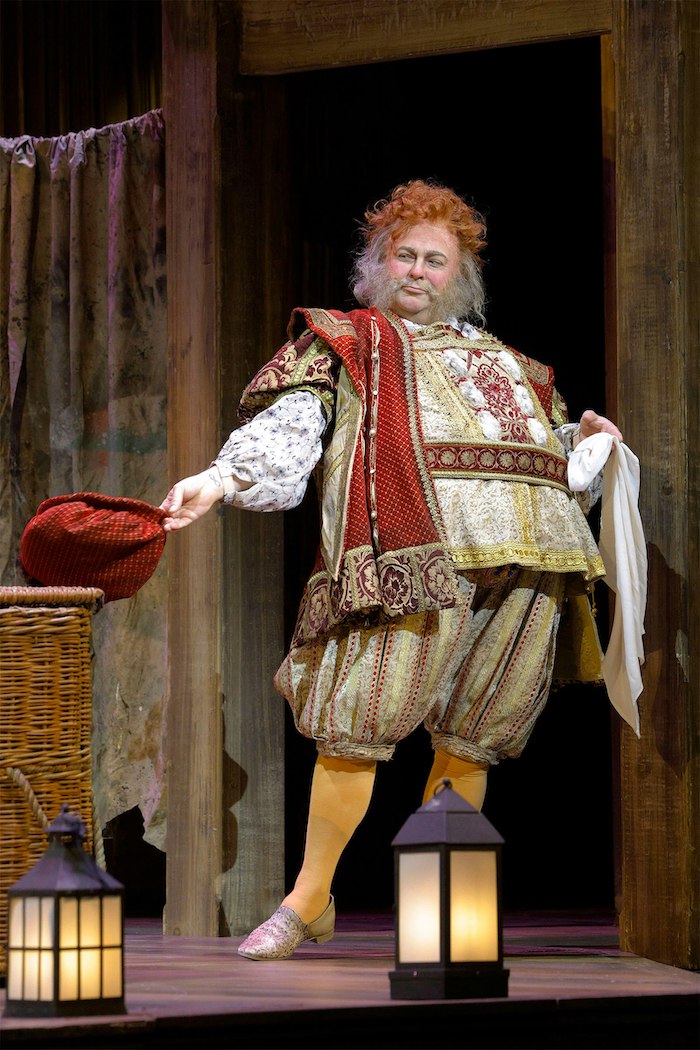
At LA Opera, the piece arrives as precisely that, motion that is rollicking, physical, and gleefully undignified. Bass baritone Craig Colclough is ideally cast in the title role, encased in a rotund body suit that becomes an instrument of comedy in its own right. He slips, tumbles, is bundled into baskets and hauled about the stage, all while preserving Falstaff’s absurd self regard, a pomposity so inflated it becomes, paradoxically, touching. Colclough does not merely play Falstaff, he inhabits the man’s delusion of grandeur, letting it wobble but never quite collapse. Opposite him, mezzo soprano Hyona Kim relishes the role of Mistress Quickly, the conspiratorial intermediary who delights in outwitting Falstaff at every turn. Her famous reverenza becomes less a polite gesture and more a sly instrument of mockery, delivered with comic precision and a sense of control that anchors the women’s plot.
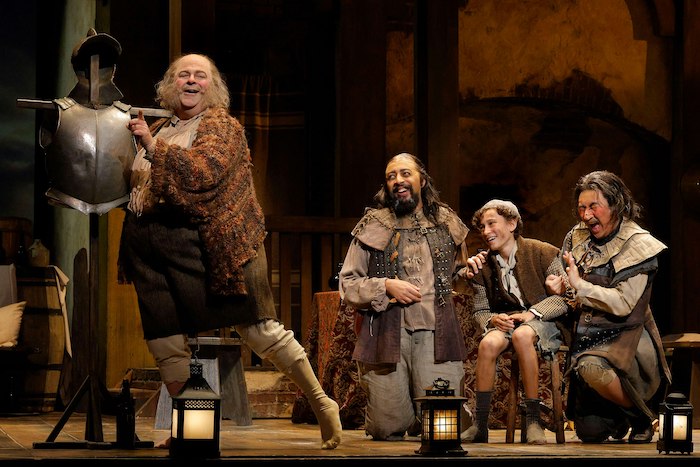
In the pit, James Conlon, preparing to take his leave after a defining tenure with the company, draws out the score’s mercurial textures with a seasoned hand. There is buoyancy without fuss, clarity without pedantry. The ensembles breathe, accelerate, and land with the ease of long familiarity. If this is a farewell, it is an elegant one. The staging, by Adrian Linford, resists the temptation toward Tudor excess. Instead, it favors a measured authenticity that allows the comedy to emerge from character rather than ornament. Nowhere is this more effective than in the final scene at Windsor Forest, where the midnight revel near Herne’s Oak turns gently uncanny. The space darkens, textures thin, and the opera’s laughter acquires a faint, ghostly edge before resolving into its famous closing fugue.
That fugue, “Tutto nel mondo è burla,” all the world is a jest, lands not as a punchline but as a philosophy. In choosing comedy as his last word, Verdi reframes his own legacy. After a lifetime of jealousy, betrayal, and death, he offers instead a vision of folly shared and forgiven. It is, in its way, the most generous of endings. As part of Verdi’s canon, Falstaff does more than provide contrast. It completes the picture. Here is the same composer, but lightened and liberated, speaking not of what destroys us, but of what makes us laugh at ourselves and perhaps be kinder for it.
— Ghalib Dhalla
“Falstaff” plays through May 10th at the LA Opera. For more information visit https://www.laopera.org/

