
A few months ago, a friend insisted, “If the Batsheva Dance Company ever performs in LA, you must go.” Last Saturday, I finally understood why. Witnessing the U.S. premiere of MOMO at the breathtaking Dorothy Chandler Pavilion was not just an evening of extraordinary dance—it was an experience that bypassed the intellect and went straight to the soul.
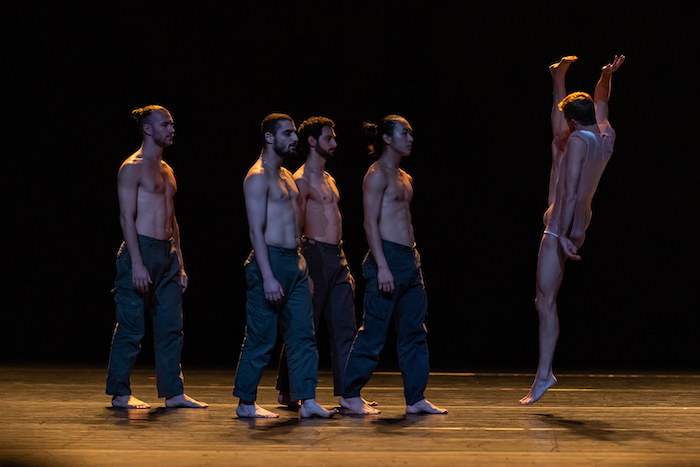
The performance began almost imperceptibly. The house lights were still on, the audience engaged in pre-show chatter, when four male dancers—bare-chested, wearing only cargo pants—entered the stage from the back left. Their steps were quiet, deliberate. And then, as if by some unseen force, the theater fell into silence. From that moment on, for seventy spellbinding minutes, we were entirely in their grasp—a trance induced by movement, music, and light, seamlessly woven together.
For seventy spellbinding minutes, we were entirely in their grasp—a trance induced by movement, music, and light, seamlessly woven together.
According to Batsheva, MOMO has “two souls.” One reaches deep into the earth, embodying the archetypal rawness of masculinity, while the other searches for individuality—a force alternately orbiting and breaking away, allowing space for tenderness and catharsis. This duality was powerfully realized in a moment of striking contrast: individual dancers, spaced across the vast stage, moved with breathtaking fluidity on ballet barres, their precision and grace so affecting that it brought tears to my eyes. At the center, Londiwe Khoza seemed to float, embodying both strength and vulnerability. Then, in a dramatic shift, the barre was raised vertically and transformed—first into what resembled a gallows, then a cross. A lone dancer took his place upon it, arms outstretched, evoking a religious tableau as Arca’s haunting Madre Acappela filled the space. It was a moment of stark, evocative beauty—one of many that lingered long after the final bow.

At the heart of Batsheva’s artistic force is Ohad Naharin, the company’s house choreographer and the mastermind behind the Gaga movement language. Naharin, who served as Batsheva’s artistic director from 1990 to 2018, is one of contemporary dance’s most visionary figures, honored with an honorary degree from Juilliard and France’s Chevalier de l’Ordre des Arts et des Lettres. His work has been widely documented, most notably in Mr. Gaga: A True Story of Love and Dance and Netflix’s MOVE, the latter dedicating an entire episode to his radical approach to movement.
Naharin’s wife, Eri Nakamura, not only designed MOMO’s minimalist, pastel-hued costumes but also performed in the piece with the same quiet precision that defined its aesthetic. The soundscape was equally masterful, featuring Landfall by Laurie Anderson and Kronos Quartet, alongside compositions by Philip Glass, Arca, and “Maxim Waratt”—a pseudonym Naharin adopts for his own compositions, crafted specifically for Batsheva.

When the final note faded, the silence broke in a thunderous standing ovation—a collective expression of awe and gratitude for what had just unfolded onstage. For those who live for dance, two things are now on my to-do list: find Gaga movement classes in Los Angeles, and ensure I don’t miss the upcoming 2025 Glorya Kaufman Dance Series at the Music Center. With Alvin Ailey American Dance Theater, Grupo Corpo, and Boston Ballet’s Swan Lake in the lineup, the spell of MOMO may only be the beginning.
— Rosane Grimberg
For more information on shows at the Music Center, please visit https://www.musiccenter.org/

