
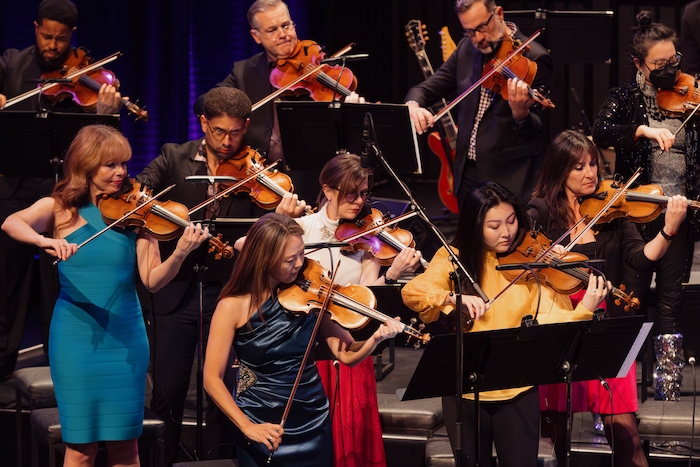
The intimate Bram Goldsmith Theater at the Wallis Annenberg Center for the Performing Arts recently hosted the final of four luminous performances celebrating the extraordinary musical legacy of Quincy Jones. Quincy’s World: The New Founding Father of American Music, presented by MUSE/IQUE in collaboration with The Wallis, proved both a heartfelt tribute and a joyous musical journey through one of the most influential careers in modern music.

Leading the evening was the ever-charismatic Rachael Worby, Artistic and Music Director of MUSE/IQUE, who conducted the orchestra while guiding the audience through Jones’s remarkable seven-decade career. With the ease of a seasoned storyteller, Worby wove together music, history, and personal anecdotes, illuminating the collaborations and innovations that shaped Jones’s singular genius.
The evening began outdoors in the charming Jamie Tisch Sculpture Garden, where guests gathered for drinks accompanied by live jazz—an elegant prelude that set the tone for the celebration to follow. Once inside the theater, the music took center stage. Grammy Award winner Brandon Victor Dixon delivered a silky, effortlessly stylish rendition of “Fly Me to the Moon,” evoking Jones’s iconic arrangements for Frank Sinatra. Electrifying vocalist Vanessa Bryan followed with a powerful interpretation of “Bewitched, Bothered and Bewildered,” her voice filling the theater with sweeping emotional intensity.
“Quincy Jones didn’t just shape American music, he expanded its possibilities.”
As the program unfolded, the audience traveled through the many musical worlds Jones helped shape—from jazz standards to pop milestones. Songs associated with Michael Jackson, including “Human Nature” and “The Way You Make Me Feel,” were brought vividly to life while nostalgic photographs illuminated the screen behind the orchestra, capturing Jones’s radiant smile and the constellation of artists who shared his journey.
Worby’s anecdotes added delightful depth to the evening. With warmth and humor, she recounted how persistent Jones had been in persuading Steven Spielberg to direct “The Color Purple.” Before the orchestra performed the film’s poignant theme, she shared another fascinating story: how legendary composer John Williams once sought Jones’s blessing to adapt the score for violin to be performed by the incomparable Itzhak Perlman on his treasured 1714 Stradivarius. For this evening’s performance, Worby unveiled a special surprise—the opportunity to hear a magnificent 1716 Stradivarius violin, exquisitely played by concertmaster Alyssa Park. The instrument’s luminous tone filled the hall with breathtaking warmth, creating a moment of pure musical magic.
Among those in attendance was Monica Mancini, daughter of the legendary composer Henry Mancini, joining others in honoring Jones’s extraordinary legacy. To close the evening, Bryan brought the audience to its feet with an exuberant rendition of “Let the Good Times Roll,” while images of Jones alongside his lifelong friend Ray Charles—whom he met as a teenager—filled the screen behind her. It was a fitting finale: joyful, nostalgic, and brimming with gratitude for a musical life that touched generations.
The celebration also marked the beginning of MUSE/IQUE’s 2026 season, Where the Heart Is, which promises more imaginative programming, including Back to Oz and Defiantly Joni. Meanwhile, The Wallis continues its vibrant 2025–2026 Without Limits season, offering audiences an eclectic mix of jazz, contemporary dance, theater, and more. If Quincy’s World reminded us of anything, it is that Quincy Jones did not simply shape American music—he expanded its possibilities, leaving behind a soundtrack of joy that continues to resonate today.
— Rosane Grimberg
 indulge