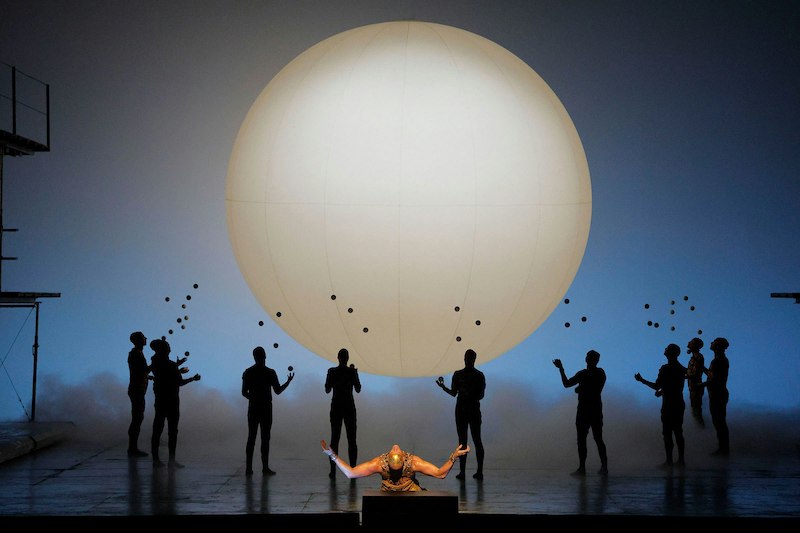
The Dorothy Chandler Pavilion recently offered audiences the rare privilege of encountering Akhnaten, Philip Glass’s mesmerizing 1983 opera—an evening that felt less like conventional theater than a kind of ritual unfolding in sound, movement, and image. Presented by LA Opera in a co-production with the English National Opera and created in collaboration with the British theater company Improbable, the work features a libretto by Glass with Shalom Goldman, Robert Israel, Richard Riddell, and Jerome Robbins. The result is a hypnotic theatrical meditation on the rise and fall of the Egyptian pharaoh Akhnaten, a figure whose radical religious vision continues to fascinate historians and artists alike.
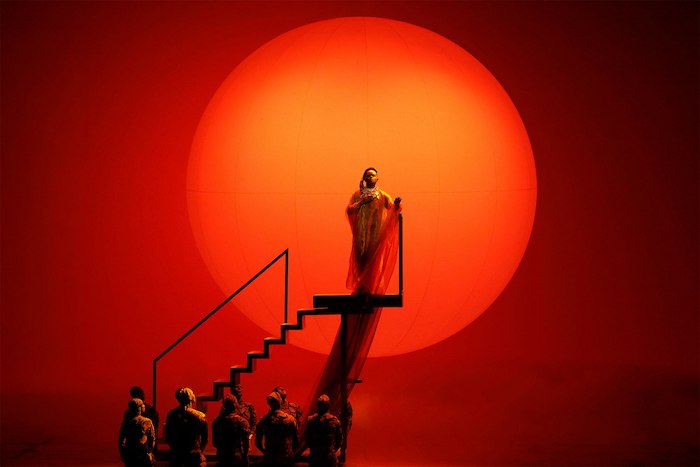
A thoughtful pre-performance talk by Dr. Tiffany Kuo illuminated two symbolic pillars that shape the opera’s world: the heart and the sun. Akhnaten’s life—believed to have spanned roughly thirty-five years—echoes through the structure of the piece itself. Over the course of its three-and-a-half-hour duration, time seems to stretch and compress so that each hour of performance reflects nearly a decade of the pharaoh’s life. Movements onstage unfold with deliberate slowness, gestures suspended in time as if bearing the weight of years. What might initially resemble slow motion gradually reveals itself as something far more profound: the sense of an entire life unfolding before our eyes. Paired with Glass’s pulsating minimalist score, the effect becomes deeply immersive—less a narrative than a sustained state of contemplation.
“The result is hypnotic: a fusion of music, movement, and imagery that turns ancient history into living theater.”
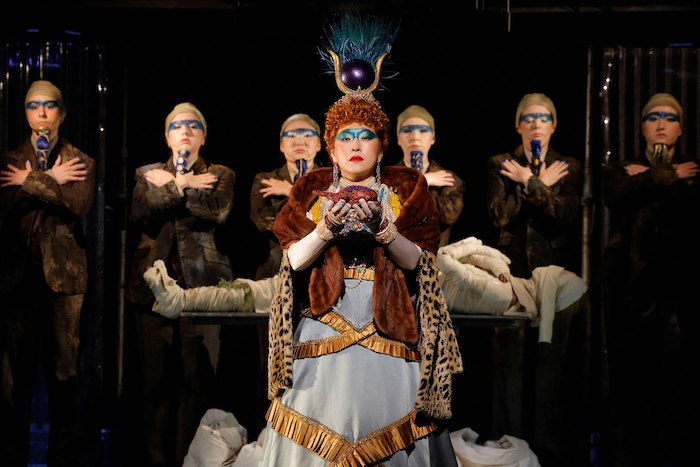
The opera opens with a solemn ritual drawn from the Egyptian Book of the Dead, depicting the weighing of the heart of the deceased pharaoh Amenhotep III against the feather of Ma’at, goddess of truth and cosmic order—the final judgment that determines whether the ruler may enter the afterlife. Director Phelim McDermott brings this ancient world vividly to life through a visual language of extraordinary imagination. The stage fills with spectacular imagery: elaborate costumes crowned with animal heads, plumes, and intricate beadwork that evoke both the mystery and majesty of ancient Egypt.
From there the narrative follows Akhnaten’s birth, coronation, and revolutionary religious vision—the establishment of a monotheistic worship centered on the sun. A radiant disc of light looms behind him, reinforcing his belief that he is the son of the sun god. As the drama unfolds, Glass’s score mirrors the shifting emotional landscape. Tempos expand and contract, and an inventive signature of this production—a troupe of jugglers—translates the music into movement. Manipulating balls with astonishing precision, their patterns accelerate and slow in hypnotic dialogue with the orchestra, becoming a visual embodiment of the score’s rhythmic pulse.
Among the evening’s standout performances, Grammy-winning bass-baritone Zachary James commands attention as Amenhotep III. With imposing stage presence and a richly resonant voice, he anchors the opera’s opening moments with gravitas and grandeur. Countertenor John Holiday brings an otherworldly beauty to the title role, his luminous timbre floating above the orchestra with haunting clarity. His voice finds a striking complement in the warm mezzo-soprano of Sun-Ly Pierce as Queen Nefertiti; together their duets shimmer with emotional intensity, lending human tenderness to the opera’s monumental scale.
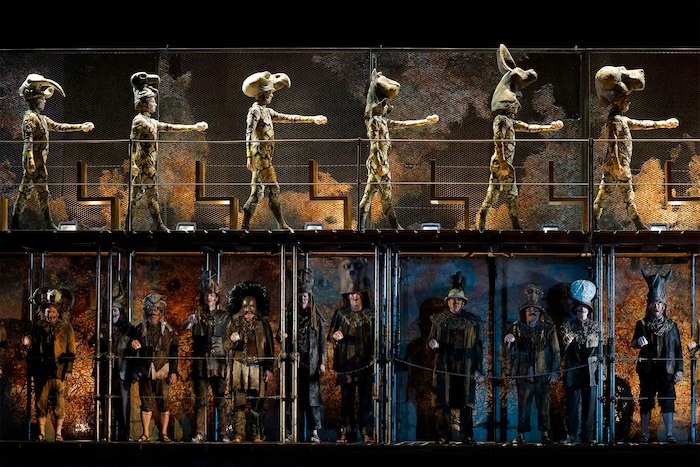
Whether encountered by seasoned opera lovers or curious newcomers, Akhnaten offers something rare: an experience that transcends conventional storytelling. In Glass’s hands—and in this extraordinary production—the story of a pharaoh becomes something timeless, a meditation on power, faith, and mortality that lingers long after the final note fades. Like the sun it celebrates, the opera casts a light that reaches across centuries.
— Rosane Grimberg
Akhanaten plays through March 22nd. More information at https://www.laopera.org/
 indulge