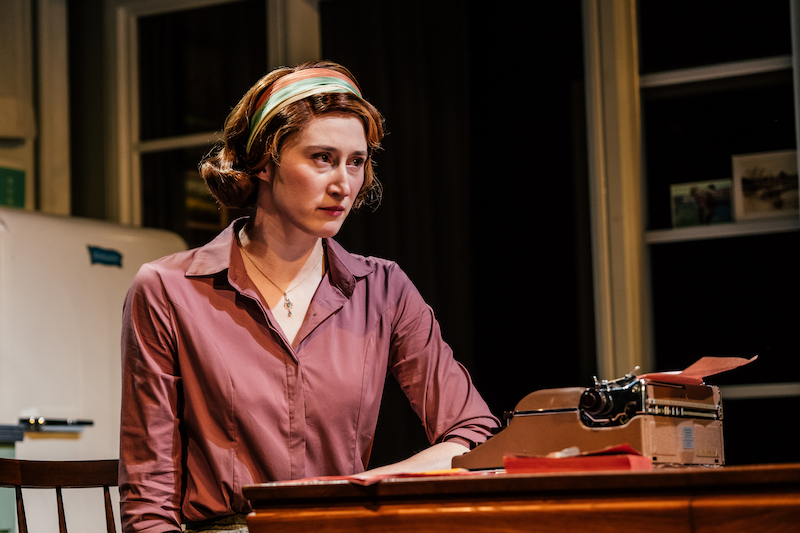
From its first moments, Sylvia, Sylvia, Sylvia announces itself as something rare. A literary chamber piece that never feels airless. It is, quite simply, one of the most gripping productions the Geffen has mounted in recent seasons, a play that hums with psychological voltage and never once loosens its hold.
The ensemble is uniformly superb, navigating tonal whiplash with astonishing fluency. Humor gives way to dread, intimacy curdles into accusation, and then, just when the atmosphere threatens to collapse under its own emotional density, the writing pivots again. There is no slack in the structure. At one hour and forty minutes, Beth Hyland’s play unfolds without a single inert beat.
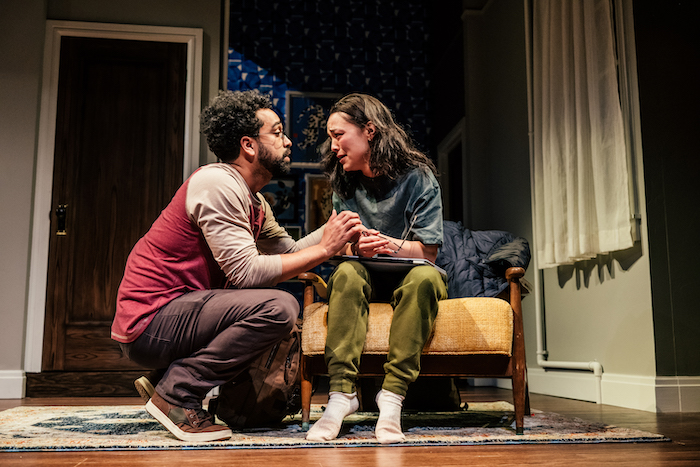
The scenic design by Studio Bent deserves particular praise. Time shifts between the present day and the early 1960s occur with such fluidity that one barely registers the mechanics behind them. Rooms dissolve into memory; memory sharpens into confrontation. The transitions feel less like technical feats than psychological slips, as though the past is not being staged but simply returning.
“One of the most gripping productions the Geffen has mounted in recent seasons.”
Of the stellar cast, Marianna Gailus is particularly electrifying. Her Sylvia carries both radiance and peril, recalling a young Meryl Streep in the early, nervy vulnerability of Plenty, that sense of intelligence and emotion so acute it borders on combustive. Gailus captures the quicksilver shifts of a woman at once incandescent and unraveling.
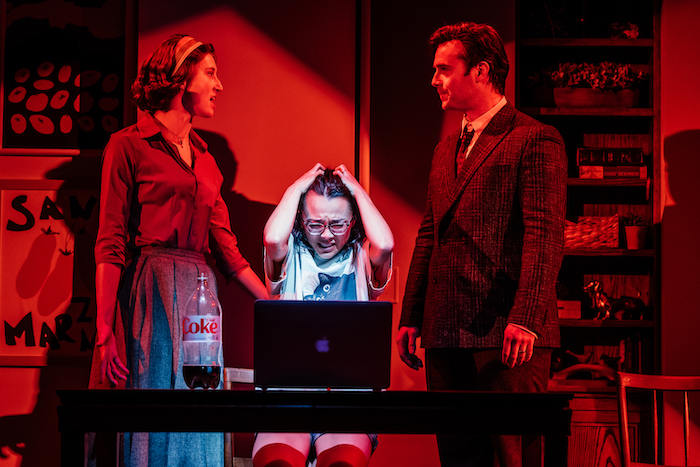
The play invokes the historical figure of Sylvia Plath without reducing her to a footnote of tragedy. Plath, abandoned wife of Ted Hughes, mother of two, and author of poems that mapped her psychological descent with searing precision, ended her life at thirty, yet left work that remains indelibly etched in the American canon. Here, even the specter of that suicide is handled with tonal dexterity: referenced with dark humor and a lightness that neither trivializes nor sensationalizes it. The balance is astonishing, and it speaks to Hyland’s deft control of a mirrored narrative.
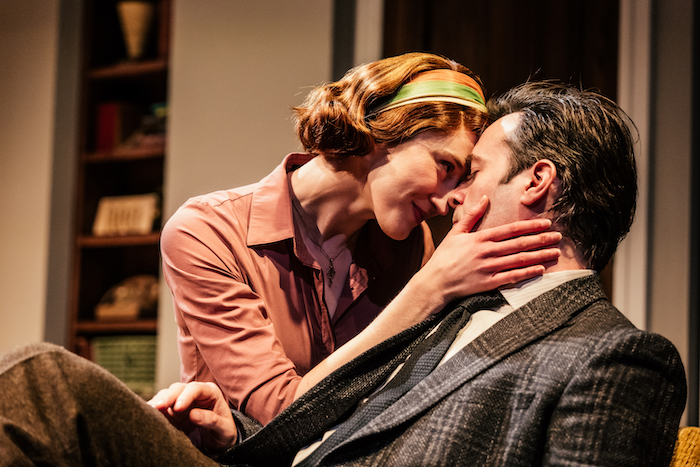
As Sylvia (Gailus) and a smoldering Ted (Cillian O’Sullivan) fracture under the strain of ambition and betrayal, a contemporary couple inhabiting the same Boston apartment wrestles with eerily similar fault lines. Sally (Midori Francis), once celebrated for a breakout debut novel, is now stalled creatively, emotionally, existentially. Her husband Theo (Noah Keyishian) stands at the opposite trajectory: freshly crowned with a major literary award and poised for a prestigious post at Columbia University, his ascent sharpens the imbalance between them.
Sally’s turmoil is layered. She is reeling from a miscarriage, ambivalent about motherhood, wary of her marriage, and paralyzed by writer’s block so severe it threatens legal consequences. The ghosts of Sylvia and Ted do not merely haunt the apartment; they agitate it, provoke it, and at times seem to feed upon Sally’s instability.
What makes the play so riveting is not its ghost story apparatus but its interrogation of artistic identity. Hyland suggests that genius and self-annihilation are dangerously adjacent myths, especially for women whose ambition collides with domestic expectation. The play is ultimately less about Sylvia Plath than about the inheritance she represents, the seductive narrative of the tormented artist, and the question of whether great art, as Ted observes, is born of pain.
Under the astute direction of Jo Bonney, the cast sustains a taut psychological rhythm. There are confrontations that sting, silences that throb, and moments of humor so dry they land like survival tactics. If the Geffen’s season sought a work that is both intellectually muscular and theatrically alive, Sylvia, Sylvia, Sylvia is it. A play that respects its audience’s intelligence while gripping their nerves.
— Ghalib Dhalla
“Sylvia, Sylvia, Sylvia” plays through March 8th at the Geffen Playhouse. More info at https://www.geffenplayhouse.org/
 indulge