
Stereophonic is a play that doesn’t so much unfold as it records itself—layer by layer, ego by ego, harmony by fragile harmony. From its opening moments, it makes clear that this is not a conventional narrative but an immersion into the beautiful, bruising process of making art while everything else threatens to fall apart.

Set largely inside a recording studio in the mid-1970s, the play has inevitably drawn comparisons to the real-life saga of Fleetwood Mac and the tortured creation of Rumours. The parallels are easy to spot: romantic entanglements, creative rivalry, chemical excess, and the strange alchemy that turns emotional wreckage into transcendent sound. But Stereophonic is far too disciplined—and too intelligent—to drift into imitation. Instead, it captures something more universal: how brilliance often emerges through fracture.
Written with remarkable restraint and insight, the play made history with 13 Tony Award nominations at the 77th ceremony, ultimately winning five, including Best Play, Best Direction, Best Featured Actor (Will Brill), Best Scenic Design, and Best Sound Design. The accolades feel less like hype than recognition of a work that quietly dominates its field.
“A raw, intimate immersion into the beautiful chaos of creation…both electrifying and deeply earned.”
The scenic design places us inside a working studio—wood-paneled, claustrophobic, and lived-in in the way creative spaces become when time stretches and patience thins. The sound design functions not merely as atmosphere but as narrative engine: silence, feedback, repetition, and half-formed melodies serve as emotional punctuation. Listening becomes as essential as watching.
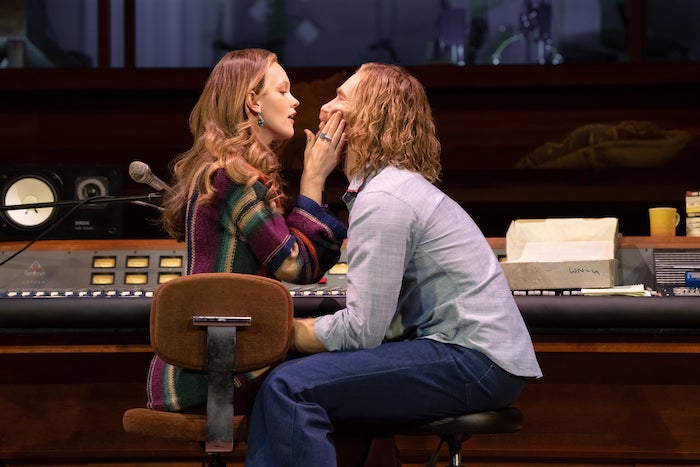
In this Los Angeles production, the performances feel especially alive. Claire DeJean’s Diana is quietly devastating, anchored by a voice that is powerful yet intimate—never showy, always truthful. When she sings, the room seems to hold its breath. Emilie Kouatchou brings equal vocal authority, her sound rich and emotionally exact, deepening the play’s ongoing conversation between music and meaning.
What Stereophonic understands—perhaps better than any recent play—is that creation is rarely romantic in real time. It is messy, repetitive, and often exhausting. Songs are born from arguments. Silence becomes a weapon. Love and resentment share the same microphone. And yet, out of this chaos, something enduring takes shape.
Director Daniel Aukin allows the play to breathe, resisting the temptation to hurry revelation. Scenes linger. Conversations circle back on themselves. The audience is asked not to observe the process, but to inhabit it. It’s a bold choice—and a deeply rewarding one.
By the end of the evening, Stereophonic leaves behind not catharsis, but recognition. Anyone who has ever tried to make something meaningful—with others, against time, under pressure—will see themselves reflected here. At the Pantages, Stereophonic arrives not as spectacle, but as a masterclass in listening. And like the greatest albums born of turmoil, it reminds us that sometimes the noise is the point—and the harmony comes later.
–Rosane Grimberg
“Stereophonic” runs through January 2nd at the Pantages Theatre. More information at https://www.broadwayinhollywood.com/
 indulge