
Puccini’s La Bohème remains one of opera’s most devastating sleights of hand: an ostensibly simple tale of young artists in 1830s Paris that, upon each revival, reveals how intimately it understands hunger—artistic, romantic, and existential. The story persists because the emotional architecture is eternal: Rodolfo, a poet with more passion than francs, meets the fragile seamstress Mimì by the glow of a dying candle; their love blooms, falters, and finally succumbs to the brutal arithmetic of poverty. Around them, Marcello, Musetta, Schaunard, and Colline parry squalor with wit, bravado, and the stubborn insistence that joy is still possible. Puccini’s genius lies in his precision—laughter echoes against thin walls of hardship, and tenderness survives only because it must.

For that reason, La Bohème, for all its velvet nostalgia, feels uncannily modern. In an era when rent outpaces reason and entire generations hover between aspiration and precarity, the bohemians’ cramped garret feels less like period décor and more like a mirror. As newly elected New York mayor Zohran Mamdani emphasized throughout his campaign, affordability is no abstraction but a lived crisis. Puccini’s young artists are today’s tenants, makers, and dreamers, leasing half-lives to a merciless market. Love cannot rescue them from material reality—but it illuminates it, revealing the human cost of systems that fail the young, the poor, and the hopeful.
‘“A revival with the sweep of cinema: Paris becomes a breathing city, and the cast, in all their fragility and fire, reflects each of us. Simply breathtaking.”
This revival, guided by the cinematic instincts of Herbert Ross (Funny Lady, The Turning Point, Footloose) unfurls with the sweep and clarity of cinema. Scenes glide rather than shift, as though the opera were unfolding from lived memory rather than theatrical construct. Gerard Howland’s scenic design deepens the illusion: vintage Paris materializes as a breathing city—the Eiffel Tower still mid-ascent toward brooding winter clouds, snow settling over cobblestones with a realism that borders on magical, the bohemians’ two-story home rendered with drafty intimacy. Even the Café Momus scene bursts with holiday exuberance, an illusion of civic warmth that throws the characters’ poverty into sharper relief.


In the hands of this formidable cast, Puccini’s melodies do more than soar—they acquire a human grain, as if pulled directly from the cold Paris air. Janai Brugger’s Mimì is a study in tenderness edged with quiet despair; her luminous voice curls around each phrase with confessional simplicity. In “Sono andati?” she achieves that rare alchemy where vulnerability gathers into truth, the aria becoming an intimate reckoning rather than a showpiece. Opposite her, Oreste Cosimo shapes a compelling Rodolfo—lean, restless, and unmistakably bohemian. His performance captures not only passion but the gnawing insecurity of a young man terrified of failing the woman he loves.

As Marcello and Musetta, Gihoon Kim and Erica Petrocelli deliver the production’s most effervescent counterpoint. Their chemistry snaps with rambunctious charm—dramatic, passionate, hilarious—and Petrocelli emerges as one of the evening’s revelations. Her radiant voice and impeccable comedic timing electrify every entrance, giving Musetta both flamboyance and emotional grounding. Kim’s baritone is rich and commanding, anchoring every scene with effortless warmth and drama.
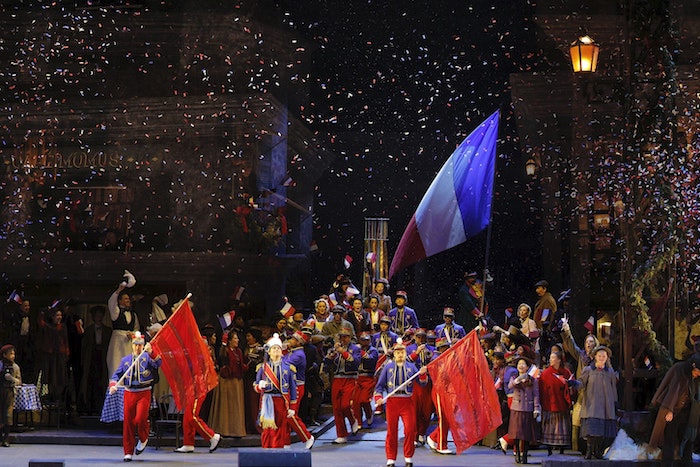
And all of it unfolds within a visual world of astonishing richness. The costumes by Peter J. Hall and Jeannique Prospere are meticulously crafted and dramatically expressive. Mimì’s humble dress and shawl, soft and subdued, speak of a life lived in half-light, while Musetta’s jewel-toned, sparkling ensembles shimmer with unapologetic vitality. The palette is historically mindful yet psychologically precise—wardrobe as character development. It is hard to fathom the sheer labor behind these garments, but the result is unmistakable: a cast dressed not merely beautifully, but truthfully.
For all its spectacle, what resonates most is the humanity: Puccini’s Paris made newly real, and a cast that meets it with heat, tenderness, and truth. This revival is not to be missed. Bravo to all!
— Ghalib Dhalla
La Boheme is playing at the LA Opera through December 14th. More at https://www.laopera.org/
 indulge