
On a balmy July evening under the stars, the Hollywood Bowl became a cathedral of cinema as two-time Oscar-winning composer Alexandre Desplat made his North American conducting debut. With the Los Angeles Philharmonic as his vessel, Desplat guided the audience through a spellbinding retrospective of his most cherished scores—an evening titled ‘The Cinematic Scores of Alexandre Desplat.”
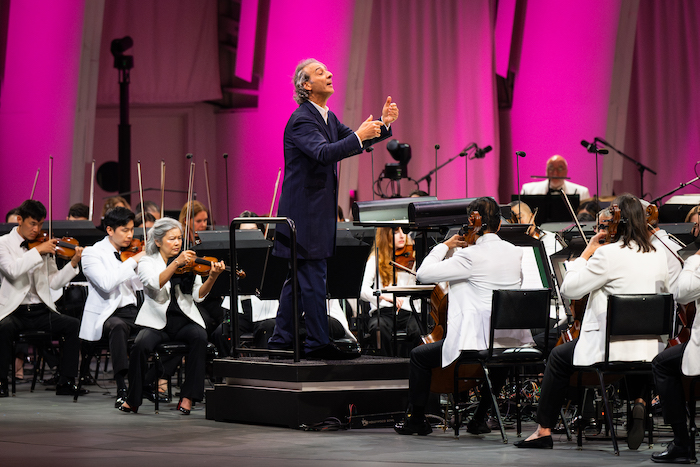
Known for his elegant fusion of classical traditions with evocative modern flourishes, Desplat’s music has become as identifiable as the filmmakers he works with. The evening’s first suite paid whimsical tribute to one such collaboration: the “Wes Anderson Suite”, which threaded together musical vignettes from Fantastic Mr. Fox (2009), The Grand Budapest Hotel (2014), and The French Dispatch (2021). Here, playful motifs danced from the strings like watercolor illustrations—airy, ironic, and perfectly Andersonian. The audience swayed and nodded, visibly charmed.
“When Desplat turned to his romantic scores, the Bowl fell into hushed reverence—gasps, sighs, and then rousing applause.”
Yet for all the idiosyncratic brilliance Desplat brings to his Anderson collaborations, it’s his more intimate, sensual scores that have etched his name into the collective heart of many cinephiles. When selections from The Girl with the Pearl Earring—the score he credited with “opening doors” for him in Hollywood—unfurled across the Bowl, followed by The Curious Case of Benjamin Button and The Shape of Water, Desplat didn’t just perform—he seduced. These are the scores that shimmer with his unmistakable signature: harp, piano, and strings spun into lush, romantic tapestries that echo the emotional immediacy of John Barry and the thematic imprint of John Williams. In these moments, the audience met him with reverent stillness. You could hear gasps. Then sighs. And finally—thunderous applause.

After intermission, Desplat returned with a more regal offering: “Suite Royale,” an elegant procession of cues from three films centered on British monarchy—Stephen Frears’ The Queen (2006), Tom Hooper’s The King’s Speech (2010), and The Lost King (2022). Here, Desplat’s orchestrations took on a stately restraint, befitting their royal subjects, while still shimmering with his characteristic warmth. It was, for many, the emotional apex of the evening.
Then, as if gently drawing the curtain on a dream, Desplat re-emerged for an encore. “I’d like to end with a waltz,” he said with a soft smile. “It’s a French tradition.” With that, he conducted the hauntingly beautiful waltz from Jonathan Glazer’s Birth (2004), leaving the Bowl suspended in a hush before erupting into its final ovation. The evening was a reminder of how deeply music can bind us to the stories we love—and how fortunate we are to hear it from the maestro himself.
— G. Dhalla
For more information please visit https://www.hollywoodbowl.com/
 indulge