
Long before it arrived onstage, The Life of Pi had already achieved literary and cinematic immortality: first as Yann Martel’s Booker Prize-winning novel, then as Ang Lee’s visually ravishing Oscar-winning film. Now, in its most daring incarnation yet, the story roars to life at the Ahmanson Theatre—not with CGI or grandiose sets, but through a breathtaking fusion of puppetry, performance, and stagecraft that suspends disbelief and dares the audience to ask: what do we choose to believe when truth itself is elusive?
Adapted with great sensitivity and narrative clarity by playwright Lolita Chakrabarti, and directed with kaleidoscopic imagination by Max Webster, this production is far more than a linear retelling. It is a theatrical act of resurrection—reviving not only the story, but the spirit, urgency, and interior world of its young protagonist. This is storytelling not as spectacle but as spiritual reckoning.
At its core is the remarkable Taha Mandviwala as Pi Patel, a role that demands emotional elasticity, physical endurance, and utter conviction. Whether wryly philosophical or on the brink of psychological collapse, Mandviwala navigates the character’s 227-day oceanic ordeal with the agility of a gymnast and the soulfulness of a poet. His performance teeters between childlike wonder and existential dread, grounding the production’s magical realism in something deeply human. It’s a feat so exhaustive one wonders how it can be replicated night after night without sheer depletion.
“Pi’s voyage is no longer just his. It becomes ours. And for a few transcendent hours, we too are cast adrift—aching, awestruck, and utterly changed.”
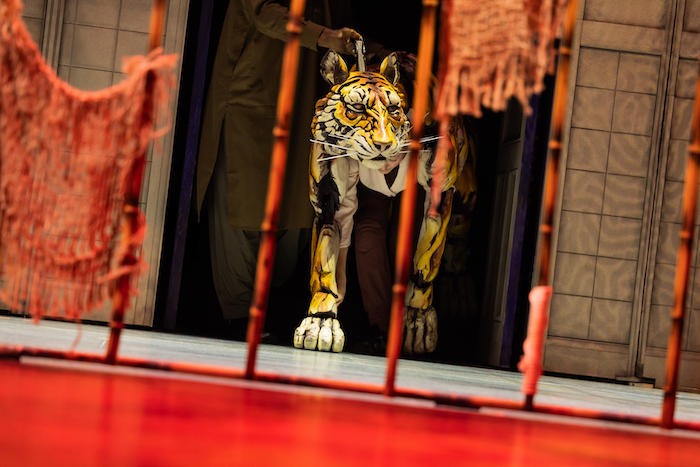
What sets this adaptation apart is its inventive use of puppetry—not as novelty but as necessity. The tiger Richard Parker, whose presence on the lifeboat is both threat and salvation, is conjured through intricate manipulation and exquisite choreography, forcing us to see not just a beast, but the embodied tension between fear and companionship. Alongside him, a zebra, a hyena, and an orangutan—each rendered with striking poignancy—animate the lifeboat’s crowded metaphor for survival.
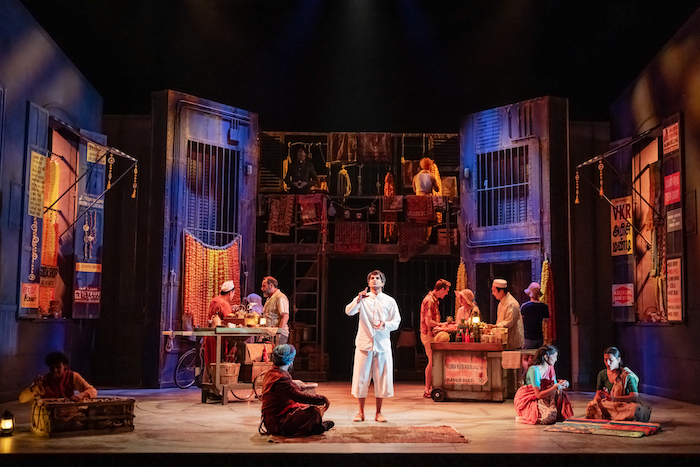
Visually, the production is a fever dream of movement, color, and design. Andrzej Goulding’s digital projections surge and shimmer like water itself, while the lighting by Tim Lutkin and Tim Deiling bathes the stage in moods that oscillate from hallucinatory to harrowing. Carolyn Downing’s sound design drives the rhythm of the narrative, sometimes whispering like memory, sometimes crashing like fate.
Even the subtleties are handled with grace. The cast’s Indian accents remain consistent and unembellished, free from caricature or mid-sentence code-switching. That linguistic authenticity—so often overlooked—grounds the story in its cultural truth and lends it an emotional weight that resists exoticization.
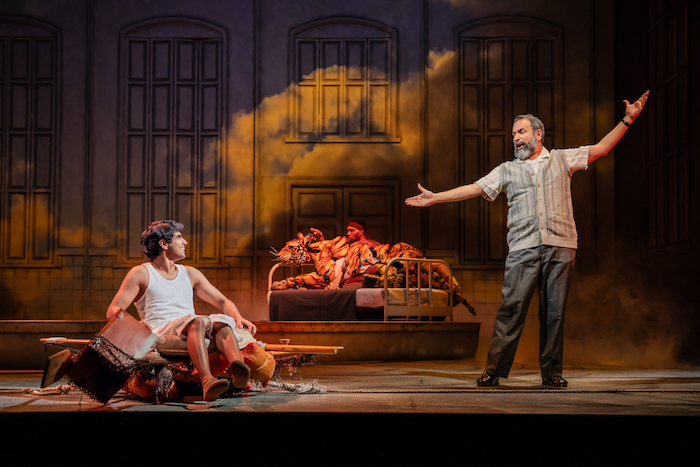
More than a survival tale, The Life of Pi is an elegy for lost innocence, a meditation on belief, and a parable about the myths we construct to survive the unbearable. In this staging, it becomes something rarer still: a deeply spiritual theatrical journey that asks not just what happened—but why we need the story to have happened the way it did. At the Ahmanson, Pi’s voyage is no longer just his. It becomes ours. And for a few transcendent hours, we too are cast adrift—aching, awestruck, and utterly changed.
— Ghalib Dhalla
“The Life of Pi” runs from now to June 1st at The Ahmanson Theatre, and from June 3rd to June 15th at the Segerstrom Center for the Arts. centertheatregroup.org/tickets/groups-and-corporate-offers
 indulge