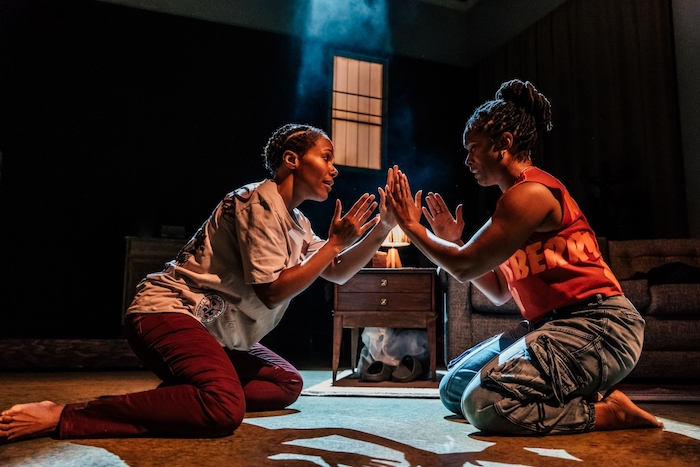
In Furlough’s Paradise, now receiving its West Coast premiere at the Geffen Playhouse under the assured direction of Tinashe Kajese-Bolden, playwright a.k. payne distills a lifetime of memory, hurt, and kinship into seventy-five electric minutes. Winner of the 2024 Susan Smith Blackburn Prize, this two-hander strips away pretense and performance, laying bare the tangle of identity, class, and familial reckoning through a sharply wrought reunion between two cousins shaped—and separated—by fate.
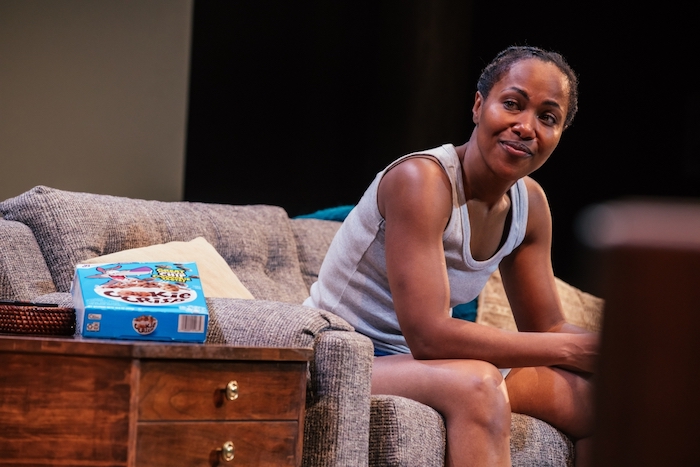
DeWanda Wise and Kacie Rogers inhabit the roles with extraordinary precision, portraying estranged relatives whose lives have diverged almost beyond recognition. Wise brings a raw, unguarded gravity to Sade, a woman battling to piece together a meaningful life within the walls of incarceration. Rogers, as Mina, captures the gnawing tension of a high-achieving outsider — someone constantly celebrated as “exceptional” yet quietly suffocated by the unspoken expectation to soothe and accommodate the unease of the privileged.
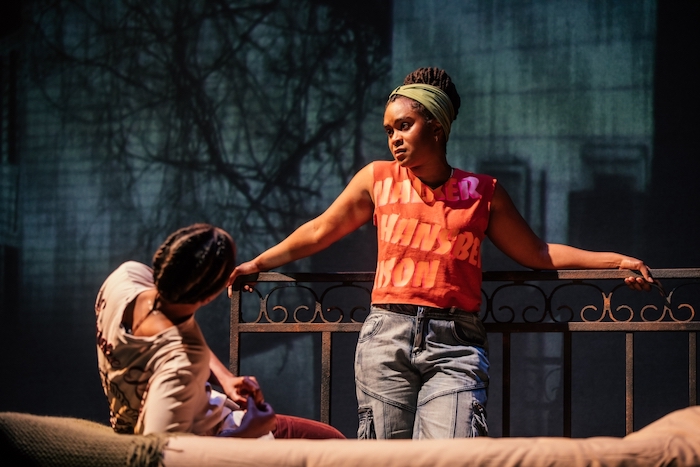
The two converge not in confrontation but in reluctant proximity, summoned home by a funeral that stirs up more than grief. Yet what begins as a brittle truce unfurls into something far more profound: a shared excavation of memory, identity, and what it means to be free when the world is intent on defining you.
“Dares to push boundaries…granting permission to rage, to yearn, to dream, and—most crucially—to exist fully and imperfectly in a world eager to define and confine.”
Visually, the production dares to push boundaries. Cinematic projections and elements of performance art weave through the action—techniques that initially flirt with feeling overly cerebral or indulgent. But as the story deepens, it becomes clear these stylized moments are not excess; they are the inner landscapes of Mina and Sade themselves—fragments of longing, fear, and reckoning made startlingly visible.

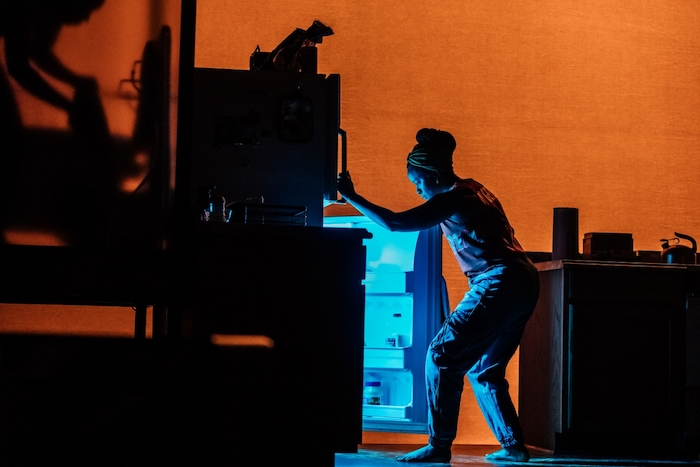
payne’s language is spare but surgical. The dialogue eschews neat exposition in favor of silence, ellipsis, and emotional shorthand—the secret language of family where a glance can wound or heal more powerfully than words. Wise and Rogers move through these rhythms with such fluidity and force that one forgets they are acting; it feels instead like eavesdropping on a conversation that has been brewing for years.
Their chemistry conjures an entire unseen history. In every sidelong glance, in every hesitation or half-smile, the audience feels the echoes of a shared past—one littered with joys and betrayals, laughter and long-buried wounds. It is a performance that demands vulnerability, not only from the actors but from the audience as well.
The brilliance of Furlough’s Paradise lies in its refusal to offer neat redemption or tidy resolution. Instead, it grants something rarer: permission. Permission to rage, to yearn, to dream, and—most crucially—to exist fully and imperfectly in a world eager to define and confine. In the tentative safety of each other’s company, Mina and Sade find a fleeting, defiant freedom. And in that space, something like paradise—fragile, hard-won—flickers into being.
— Ghalib Dhalla
Furlough’s Paradise is at the Geffen Playhouse, 10886 Le Conte Ave. in Westwood, through May 18. More information at https://www.geffenplayhouse.org/
 indulge