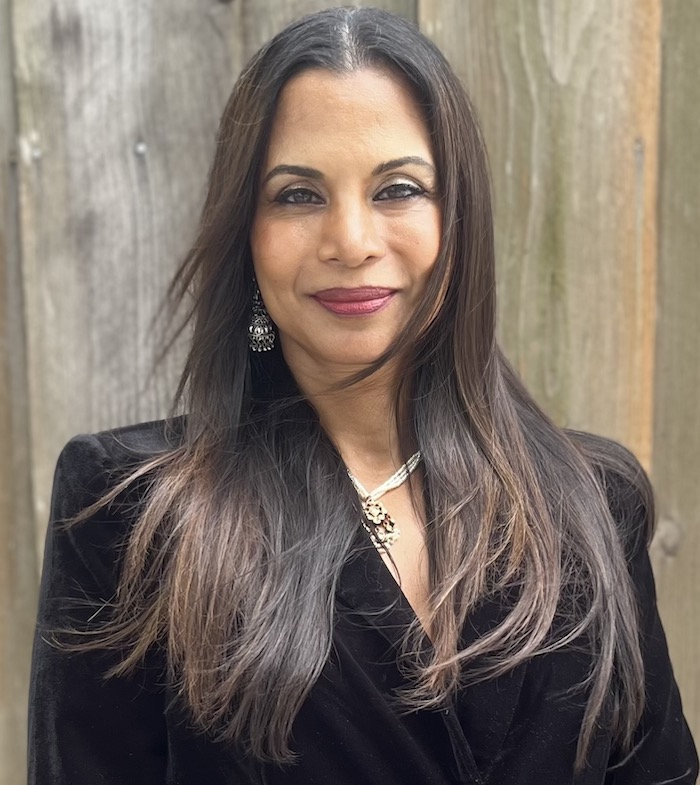
When writer Samina Ali gave birth, she woke not to joy—but to a coma, organ failure, and the loss of language, memory, and mobility. Her new memoir, Pieces You’ll Never Get Back (Catapult, 2025), revisits the trauma that nearly killed her and the years it took to reclaim her voice.
INDULGE: Where were you born and raised? How did it influence your writing and your thinking about the world?
ALI: I was born in Hyderabad, India and raised both there and in the US. I happen to be raised bi-cultural and bi-lingual in two twin cities: Hyderabad-Secundrabad and Minneapolis-St. Paul. My family immigrated to Minneapolis when I was about a year old. But my parents were so rooted in India that my mom would return to Hyderabad with my two brothers and me every year. We’d stay for months. I grew up going to school in both Hyderabad and Minneapolis. It was confusing and lonely. Classmates in each city saw me as the outsider. So I turned to literature. Characters in books became friends. But even books didn’t represent how truly split my existence was, and that led me to try to capture my experience in words. Since I was growing up learning both English and Urdu, I wrote my stories in both languages. Urdu is written right to left while English is written from left to right. On the page, the two languages would crash into each other… finally representing how I felt inside.


INDULGE: This is your second book…
ALI: Yes, my first was a novel, Madras on Rainy Days, released twenty years ago! I wrote that novel through brain damage. The process was so excruciating that I couldn’t return to the desk for years. Any attempt to write brought on a massive headache. The English language had left me. Often, I wrote gibberish without realizing it. Those memories stopped me from writing. When I returned, it was to confront them.
“One of the most unfortunate things we’ve been taught is that our differences make some of us inferior. An experience with death shatters these demeaning notions. “
INDULGE: Can you tell us briefly about your current book?
ALI: Pieces You’ll Never Get Back is about how, at 29, as a young writer working on my first novel, I nearly died giving birth. I came out brain damaged. I didn’t remember my husband or having a baby. Any language other than Urdu was foreign. Medical consensus was I would never recover—much less write—again. But I don’t consider it a medical memoir. The central message is about resilience and hope.
INDULGE: Why was it important for you to open this book with spirituality?
ALI: This is one of the most important messages I’m hoping to convey. My ultimate purpose was to express how my encounter with death fundamentally changed how I live. Brain damage showed me how our identity is shaped by our brain’s wiring—taught by family, society, and our past. One of the most unfortunate things we’ve been taught is that our differences make some of us inferior. An experience with death shatters these demeaning notions. We are matter and energy, all of us, united as one humanity.
INDULGE: How did relearning language as your son was learning his first words shape your approach to language and motherhood?
ALI: When I lost my ability to speak and write, I lost the higher mental processes that make us human. It was one of the darkest periods of my life. While I still experience aphasia, losing my ability to speak properly taught me the importance of words. Letters are symbols that only have meaning because we’ve agreed they do. Without language, we are isolated. Because I was raising a newborn, I had to choose which language to speak to him. My Urdu was left undamaged, but I chose English to force myself to repair it—even though it meant he wouldn’t know Urdu. I was bereft that he didn’t know my full identity. Much to my delight, when he was in college, he learned Urdu on his own. The first time we had a conversation in Urdu, he told me he saw aspects of my personality he’d never known. It was like meeting a different mom.
INDULGE: How did you approach including medical elements in your memoir without making it too dense?
ALI: The first person to tell me to write this memoir was my neurologist. He said doctors understand brain damage from the outside, but I could write about it from the inside. His words became a guide. I wanted to capture how it feels to have brain damage: the disorientation, frustration, fear. It’s an isolating, lonely experience. We experience the world through our brains—the color of flowers, the poetry of music. What happens when the brain is damaged, and the world turns flat and meaningless?
INDULGE: If your son has read it, what was his reaction?
ALI: My son lives in London. When I mailed him the book, I wrote him a note saying, “Don’t read this and feel sad about what I’ve endured. Instead, be grateful for the miracle that is us.”
— G. Dhalla
More on Samina Ali at https://saminaali.net/
 indulge